

Why New Websites Spike, Drop, Then Slowly Rise on Googles Rankings Roller Coaster
GSC Data Case Study Confirms “Roller Coaster Effect”
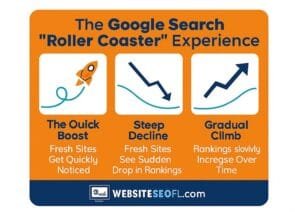 If you’ve ever launched a new website and were thrilled by a quick spike in search impressions—only to be disappointed weeks later by a dip in visibility—you’re not alone. That surge-then-drop pattern is more than a fluke. It’s a well-documented behavior in how Google evaluates and ranks new sites.
At Website SEO Florida, we’ve seen this firsthand on our own site, webseofl.com. Using our Google Search Console data, we’ll break down this trend, explain why it happens, and give some clarity on what to expect in the early months of a website’s SEO journey.
Our Data Tells the Story: The “Google Rankings Roller Coaster”
Let’s start with what we’re seeing right now.
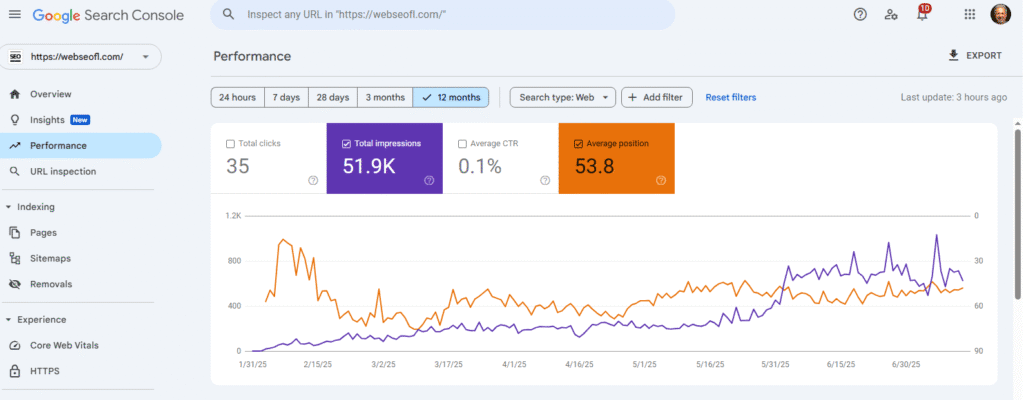 Over the past 12 months, our GSC performance chart shows the classic three-phase pattern of a rankings’ roller coaster:
Early Boost (January – mid-February 2025): A strong uptick in impressions shortly after launch.
Sharp Drop (mid-February – March): A noticeable decline in impressions and average position.
Slow Climb (April onward): A steady and gradual improvement in both impressions and ranking position.
We’re improving. Slowly—but surely. And that’s the key takeaway.
Why This Happens: How Google Handles New Sites
When you launch a new site, Google tends to temporarily boost it in rankings as part of a freshness trial. This isn’t favoritism. It’s Google collecting real-world signals quickly to determine where your content might belong in its massive index. It is the first steep uphill climb of the rankings roller coaster.
1.  The Quick Recognition Phase (aka the “Fresh Boost”)
 The Quick Recognition Phase (aka the “Fresh Boost”)
This is the honeymoon stage. Google sees a new site with clean code, some structured content, internal linking, perhaps a few backlinks, and gives it a short-term chance to “prove itself.” During this period, you might rank surprisingly well—even without domain authority.
This explains why impressions surge early, as they did for us in late January.
Supporting Stat:
According to a Search Engine Journal article from 2014, 95% of fresh websites experience a bump in visibility within the top 10 for at least one query in their first 90 days.
2. The Correction Phase (aka the “Steep Drop”)
 The Correction Phase (aka the “Steep Drop”)
Once the novelty wears off, Google begins assessing:
Are users clicking and staying on the site?
Does the content satisfy the query intent?
Are there quality backlinks from trusted sources?
Are technical issues like load speed or mobile UX affecting user experience?
As it gathers real engagement signals (or lack thereof), Google often pulls rankings back down. It’s like saying, “Thanks for showing up—now earn your place.”
For us, this drop showed up clearly through February and into March. Our CTR was low, and our pages needed refinement. But that’s normal. This is where most people panic—but it’s exactly what should be happening.
3. The Rebuilding Phase (aka the “Gradual Rise”)
 The Rebuilding Phase (aka the “Gradual Rise”)
After the dip, what comes next? A long, steady climb on the Google Rankings Roller Coaster Experience. With consistent content, technical fixes, and real link-building, your site begins earning trust.
That’s what’s happening for us now at Website SEO Florida. By improving content quality, creating targeted internal pages, and earning some backlinks, we’ve seen our impressions and ranking begin to rise again—slowly, but measurably.
We’re seeing Google test us more broadly now—more queries, more variety, better average position.
The Psychology of Google Search (Why It Matters)
Understanding this pattern helps you stay calm when rankings drop. Google’s job isn’t to “promote” websites—it’s to test, observe, and reward sites that match real-world search behavior.
Think of your website as a new product on the shelf at a major store. Google gives it a temporary front-row spot… but whether it stays there depends on how users interact with it.
This is why your CTR, bounce rate, time-on-page, and backlink profile start to matter more after that initial burst.
What the Experts Say
Don’t just take our word for it—this phenomenon is widely observed:
Cyrus Shepard (Zyppy SEO):
“Google is notorious for testing new URLs briefly in high-ranking positions before re-evaluating where they truly belong. It’s part of the system’s freshness scoring algorithm.”
Google’s John Mueller:
“With a new website, we don’t know much about the quality yet. So we may fluctuate rankings while gathering signals.”
Ahrefs Study (2020):
“Only 5.7% of newly published pages get to the top 10 in Google within a year. But the majority of those that do start seeing impressions and low-level rankings within 3 to 6 months.”
Google Patents:
Google has patented mechanisms like the “document inception date” and “freshness boosting,” both of which apply higher weighting to new content before scaling it back based on engagement.
What You Should Do in Each SEO – Ranking Phase
Phase 1: The Boost
Do:
Submit your sitemap to GSC.
Create high-quality cornerstone content.
Monitor impressions closely.
Don’t:
Assume you’re “ranking forever” based on one good week.
Pause content creation just because early data looks good.
Phase 2: The Drop
Do:
Improve on-page optimization (titles, meta, H1s).
Start building quality backlinks.
Analyze user behavior via GSC + GA4.
Fix slow page speed or mobile issues.
Don’t:
Panic or pull pages down.
Make constant changes without letting content mature.
Phase 3: The Climb
Do:
Keep publishing content regularly.
Add topical authority with blog articles.
Get mentioned in relevant directories and niche sites.
Build internal links to older posts.
Watch for keyword cannibalization and fix it.
Implement strategies to enhance AI overviews and voice search.
Don’t:
Expect daily growth.
Don’t focus on short term ups and downs but look at trends.
Forget local SEO and citations if you’re a local business.
Final Thoughts: Patience + Persistence = Growth
SEO isn’t a sprint—it’s a steady jog uphill. The early spike in search rankings might feel like winning the lottery, but it’s not sustainable unless you build the right foundation.
Our GSC data proves it. The impressions rose, dipped, and are now climbing again. That’s the reality for almost every legitimate site trying to grow organically in 2025. Follow our guidelines or hire our expert SEO service to help you land above your competition after riding the rankings roller coaster.
So if you’re seeing the same thing on your site—good. You’re doing it right.
And if you need help with keyword research, content strategy, technical audits, or link-building, or riding the rankings roller coaster, that’s where we come in.
Work With Website SEO Florida
At Website SEO Florida, we don’t just talk SEO—we live it. Our own site is our testing lab. We understand what it’s like to fight for ranking space from scratch. Let us bring that same persistence and strategy to your online or local business.
Visit webseofl.com to learn more or schedule a free consultation.